Handover
Delegation that sticks: 10-80-10 and a definition of done
Why delegated work comes back, and how to hand over so it stays handed over: the offload list, 10-80-10, a definition of done and a playbook.
6 min readAIKAA editorial
Why does delegated work come back?
Almost always for the same reason: there was no definition of done. The doer did their best, the owner fixed it «just a little», and the third time the owner did it themselves because it was quicker. The work did not come back because of a bad doer but because the handover was never finished.
Where does a handover begin?
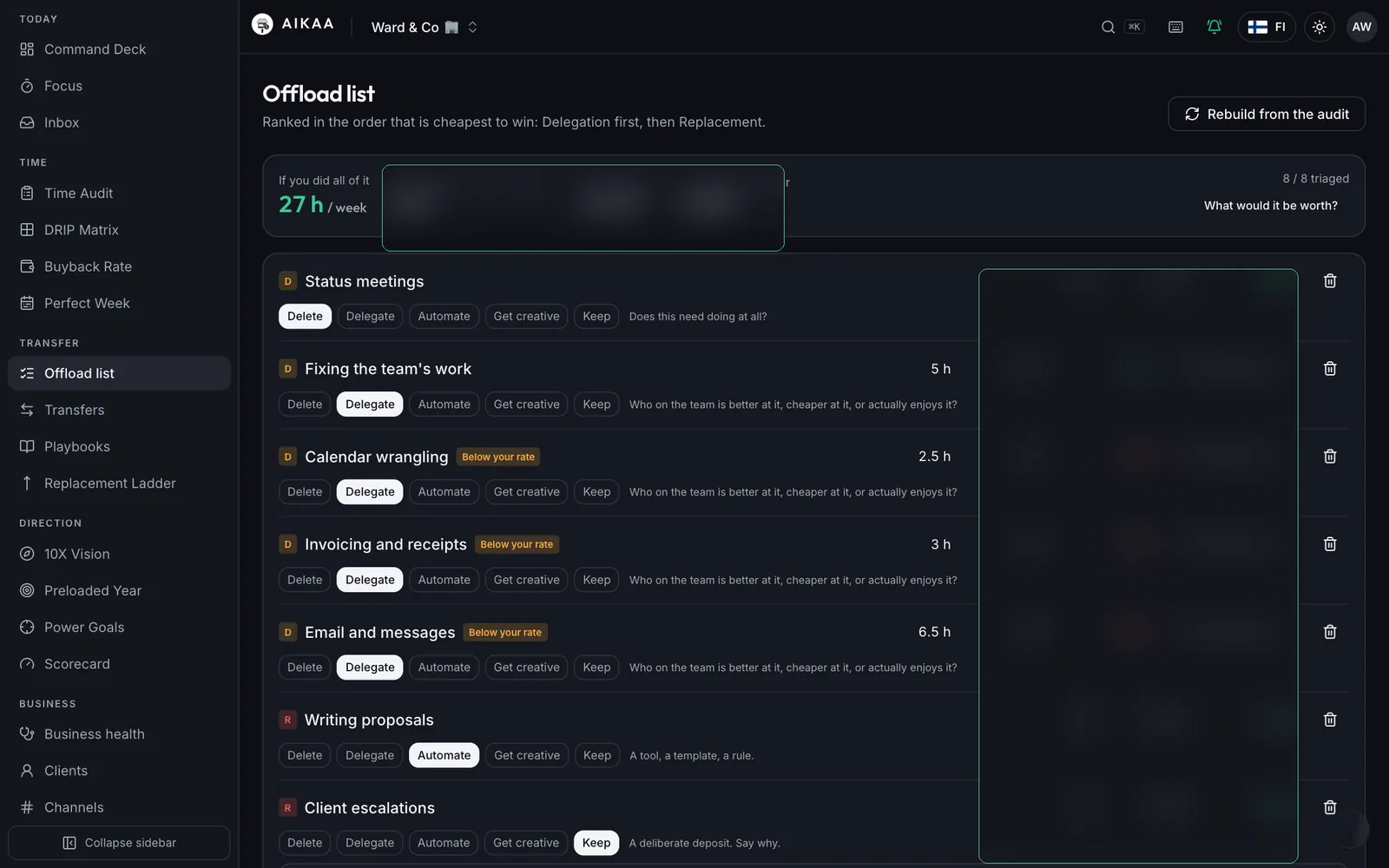
On the offload list. Every task that surfaced in the audit gets a decision there: delete, delegate, automate, redo creatively or keep. Keeping is allowed, but it needs a written reason.
 Withheld – opens to members
What does 10-80-10 mean?
- The first 10%: you set the direction, the limits and why the work is done.
- The middle 80%: the doer does the work their own way.
- The last 10%: you check against the definition of done – not against your own taste.
What goes into a definition of done?
Three things: facts (what must be true), feelings (how the client or you should feel) and functionality (what the work must achieve). In AIKAA a transfer cannot be marked as handed off until all three are written.
Who writes the playbook?
The doer, not the owner. The owner shows once, the doer records and writes, the owner reads. When the doer writes the instructions in their own words, they understand them – and the next doer learns from them.
A handover is not done when the work leaves your desk. It is done when it does not come back.
Frequently asked
What does 10-80-10 mean in delegation?
The owner does the first 10% (direction and limits) and the last 10% (checking against the definition of done), and the doer does the middle 80% their own way.
What is a definition of done?
A written description of when the work is finished: facts, feelings and functionality. It turns the check into a comparison rather than a matter of taste.
Why does the doer write the playbook rather than the owner?
Because the doer understands instructions written in their own words, and the next doer learns from them. The owner reads and approves.
AIKAA is a private membership. Every workspace is built by hand for the person who uses it, so places are filled by application.